
Car Rental in Oman: Complete Guide for Travelers
08/07/2026
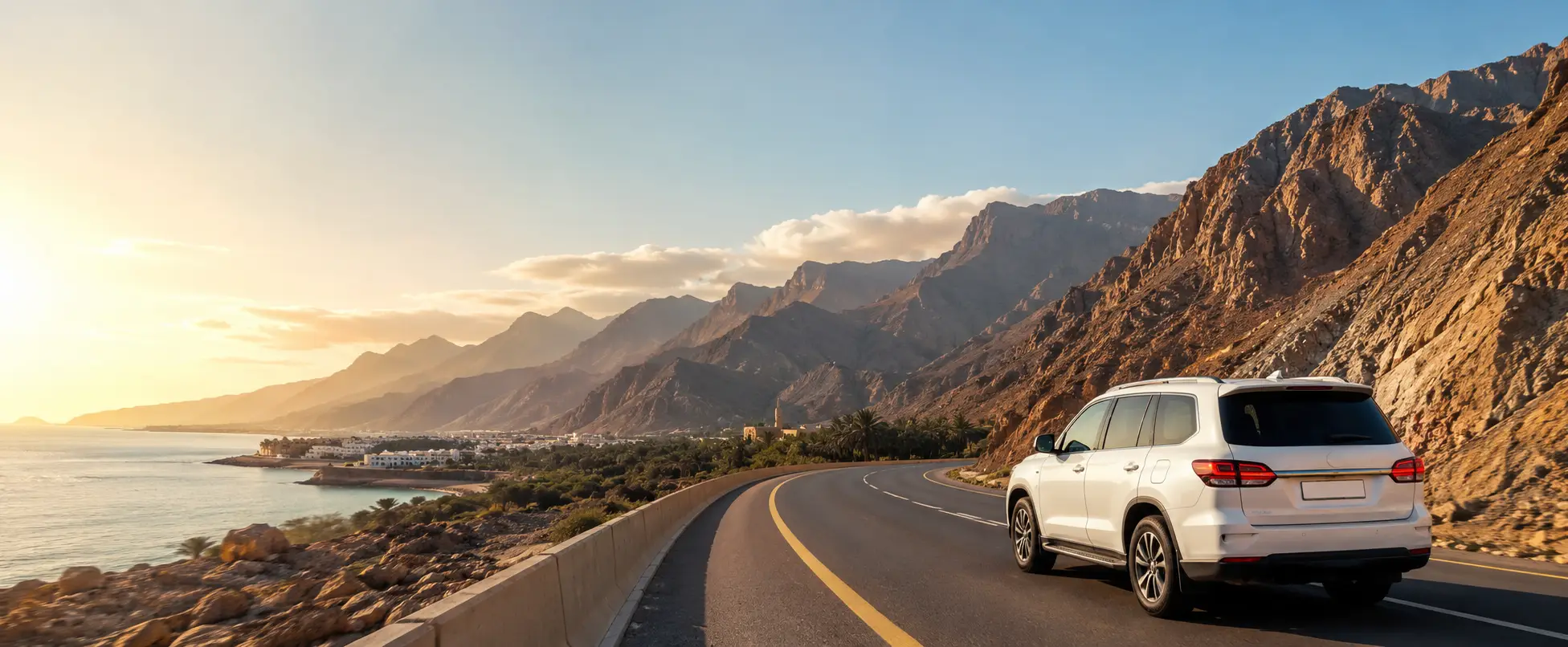
For a Muscat-only stay, you may not need a car. Once the route heads out of the city, a rental car usually becomes more useful. It lets you leave Muscat before traffic builds, spend longer at a wadi, add a fort stop on a mountain approach, or connect coastal roads with desert-edge highways in one plan. This guide explains the rental costs, car classes, pickup points, companies, documents, insurance points, driving conditions, and route checks to review before you reserve.
The pricing and rental-market figures in this article are based on the authoritative data blocks included in the page. Before the details, use these figures as planning context: the data block shows $31/day as the average listed price. The lowest listed rate is $11/day. May is the cheapest month in the set, Alamo is the lowest listed supplier, and SUV is the most common category. Your final quote may still change once dates, branch, car class, insurance, deposit, and route permission are selected.
- Should You Rent a Car in Oman?
- Oman rental car prices and budget planning
- Best Time to Book a Rental Car in Oman
- Choosing the best rental car type for Oman
- Best places to pick up a rental car in Oman
- Rental Companies to Compare in Oman
- Rental documents, age rules and deposits in Oman
- Insurance, excess and restricted roads in Oman
- Driving in Oman: road rules and safety planning
- Self-drive Oman routes and itinerary ideas
- Cross-Border, One-Way and Long-Term Rentals in Oman
- How to Book the Right Rental Car in Oman
- Oman car rental questions and answers
- Oman rental car checklist before you go
Should You Rent a Car in Oman?
Usually, yes — if you want to travel around Oman on your own timetable. The benefit is practical: you can leave Muscat early, stay longer at a wadi, stop at a viewpoint, or pause in a smaller town without rebuilding the day around transfers. A rental car usually becomes most useful outside the capital, especially on routes toward Nizwa, the Sur coast, mountain viewpoints, desert-edge stays, Salalah, or wider Dhofar.
For a resort stay, conference trip, or short Muscat-only stop, it may be better to wait or skip the rental. If tours already cover the out-of-city days, the counter visit, parking, fuel, deposit, insurance choices, and city traffic can take more effort than the car saves. In that case, taxis or transfers may be simpler.
Rent when the itinerary becomes an independent road route. Delay or skip the rental when the first days are only Muscat, a guided plan, or a resort stay. Many visitors use a mixed approach: transfers at the start, then a rental car when the route actually leaves the city.
Why a rental car helps in Oman
- Flexible timing: leave before it gets hot; come back after dinner.
- Better access: forts, wadis, beaches, viewpoints, mountain areas, and coastal pull-offs are easier when you are not waiting for a driver.
- Route control: a Muscat–Nizwa–Sur plan, or a smaller loop, is easier when each leg does not need a separate transfer.
- Comfort for groups: bags, water, snacks, and child seats stay in the same vehicle.
- Lower friction on long trips: the data’s seven-day average rental length fits the kind of loop where repeated transfers become awkward.
- Better value on multi-stop plans: the more separate transfers you would otherwise need, the more useful the car becomes.
Trips where you can skip the car
A low price is not enough reason to take the keys. If most days revolve around a hotel, conference venue, city base, or guided desert pickup, the rental may become another errand rather than a benefit. You still need a branch visit, parking, fuel, a deposit, insurance decisions, and confidence behind the wheel. If highways, mountain roads, heat, or navigation feel stressful, consider booking a driver only for the days that need one.
Rental advice by Oman itinerary
| Itinerary type | Rent or skip? | Suggested car class | Main caution |
|---|---|---|---|
| Muscat only for one or two days | Usually skip or delay | No car, taxi, transfer, or short rental | Parking and pickup time may outweigh convenience. |
| Muscat plus one or two day trips | Usually rent | Small car or sedan for paved routes | Check the exact route and return timing. |
| Northern Oman loop | Rent | Comfortable sedan, SUV, or suitable 4x4 depending on route | Mountain, wadi, and remote-road choices change vehicle needs. |
| Salalah and Dhofar | Often rent | Small car, sedan, or SUV by season and route | Check mountain and coastal road suitability before assuming any car will do. |
| Family or group trip | Rent | SUV, large car, or van | Book child seats, luggage space, and extras before supply narrows. |
| Desert-edge, camping, or special route | Rent only with the right terms | Suitable SUV, true 4x4, or specialist vehicle | Written permission and coverage exclusions matter. |
Before choosing a car class or pickup point, review the basic rental and driving facts first. These figures explain the planning assumptions used throughout this guide.
Driver facts for Oman travel
Languages
Arabic, English, Baluchi
Currency
OMR
Drive on
Right-hand side
Country code
+968
Average listed price
$31 per day
Average car rental length
7 days
Speed limit within town
40–80 km/h or 25–50 mph
Speed limit out of town
90–120 km/h or 56–75 mph
Acceptable limit of BAC
0.00%
Average gas price
$0.62 per liter or $2.35 per gallon
Lowest gas price
$0.57 per liter or $2.16 per gallon
Highest gas price
$0.73 per liter or $2.76 per gallon
Rating
9.4 / 10
How to use this guide without overplanning
Use this guide in the same order you would make the booking decision. First, decide whether the car truly improves the itinerary. Then build a rough budget from the average daily price and vehicle-type data. After that, compare car class, pickup point, supplier, documents, insurance, and route rules. This order helps prevent choosing a cheap car first and reshaping the trip around a vehicle that may not fit.
In practice, the starting point changes by traveler. A visitor with two nights in Muscat and one paved day trip can begin with cost and convenience. A family doing a northern loop should think first about luggage, child seats, comfort, and route suitability. A traveler interested in desert-edge scenery or mountain roads should check permission and vehicle capability before comparing the cheapest results. The same country can require very different rental decisions.
Keep the decision to rent separate from the decision to drive every day. You might use the car for the road-trip days, leave it at the hotel for a rest day, or hand one difficult route to a local operator. That can still be a self-drive Oman trip; it just does not need to be self-drive every hour.
Oman rental car prices and budget planning
Use the data block here as the starting point: it gives $31/day as the average listed price. Build the first budget from that number, then expect the quote to change once the booking form adds dates, branch, supplier, car class, insurance, mileage, extras, deposit terms, or route permission.
For rough planning, seven days at that average comes to about $217/week. Thirty days at the same average comes to about $930/month. These are simple derived planning estimates, not separate weekly or monthly quotes. Real long-term rental offers can still use different mileage rules, maintenance conditions, deposit terms, or discounted rate structures.
Budget estimates by rental length
| Planning item | Value to use | How to interpret it |
|---|---|---|
| Average listed daily price | $31/day | A general planning baseline before car class, supplier terms, insurance, and pickup details are compared. |
| Lowest listed price | $11/day | A low-end listed example, not a guaranteed total for every date or route. |
| One-week estimate | About $217/week | A derived estimate using $31 × 7. It is useful for budgeting a common seven-day rental length. |
| Thirty-day estimate | About $930/month | A derived estimate using $31 × 30. Confirm actual monthly terms with suppliers before using it for a budget. |
The lowest visible rate still needs a careful read. Look beyond the daily number and check the deposit, mileage cap, branch hours, child-seat cost, insurance excess, and any route exclusions. A cheap quote is useful only when the conditions also fit the trip.
The biggest price difference is often the car class rather than two similar suppliers. Use this chart to compare small cars, SUVs, vans, large cars, and premium cars across the year.
Vehicle-type price comparison for Oman
Use the vehicle-type comparison as a quick way to see how the budget changes when you move from a small car to an SUV, van, or premium vehicle.
Small car rental price guide for Oman
Small car rentals in Oman typically cost around $21 per day. The best time to book is May, when prices average $15 per day which is about 29% less than the yearly average. Small cars are usually about 67% cheaper than the all-car-type average in Oman, making them ideal for budget-conscious travelers.
Using the vehicle price chart correctly
Read this chart first as a price map, then as a suitability check. Small cars average about $21/day, so they usually make the most sense for paved city and highway routes. SUVs sit around $69/day. That increase can be worth it for family luggage, longer driving days, or rougher access, but it is still a budget increase. Medium cars average around $75/day; large cars around $93/day; luxury cars around $103/day; vans around $157/day.
Do not read those averages as fixed quotes. A small automatic can price higher during busy dates, and a larger car can look more reasonable in a slow period. The main point is the size of the jump: moving from a small car to a van or premium car can reshape the trip budget.
Start with the route, not just the price. A small car can work well in Muscat, on paved day trips, or for two people with light luggage. It may become a weak choice if the plan includes steep mountain access, family baggage, long remote drives, or a road the supplier limits to a more capable vehicle. Before you book on price alone, check the car-type decision guide and the insurance and road-restriction section.
What the cheap car examples really mean
The cards below are examples, not promises. They show how wide the listed daily prices can be: Toyota Yaris and Suzuki Swift Dzire appear at $11/day, while SUV and premium examples climb quickly. They do not guarantee the same model, rate, pickup point, transmission, insurance package, or deposit condition for your own dates.
Use the cards as a shortlist prompt. When a specific vehicle example looks attractive, check whether the offer says “or similar,” what insurance is included, whether mileage is limited, whether the supplier requires a credit card, and whether the pickup location fits your first day. Also confirm that the vehicle has enough seats, bags, and doors for the people actually traveling.
The examples below show listed daily prices for specific vehicles and categories. Treat them as examples, then check the final quote conditions.
Low-price rental car examples in Oman
-
Toyota Yaris
Small2 seats · 2 bags · 4–5 doors
-
Suzuki Swift Dzire
Small4 seats · 2 bags · 4–5 doors
-
Volkswagen Jetta
Medium5 seats · 3 bags · 4–5 doors
-
Mazda Mazda6
Medium5 seats · 3 bags · 4–5 doors
-
Nissan Altima
Large5 seats · 2 bags · 4–5 doors
-
Class Economy SUV
SUV2 seats · 2 bags · 4–5 doors
-
Mitsubishi Montero
SUV5 seats · 2 bags · 4–5 doors
-
Suzuki Swift
Small2 seats · 2 bags · 4–5 doors
-
Class Premium Car
Premium5 seats · 5 bags · 4–5 doors
-
BMW 5 Series
Premium5 seats · 5 bags · 4–5 doors
-
Toyota Land Cruiser Prado
SUV5 seats · 5 bags · 4–5 doors
-
Peugeot 2008
SUV4 seats · 2 bags · 4–5 doors
-
Class Intermediate SUV
SUV5 seats · 3 bags · 4–5 doors
-
Nissan Xterra
SUV5 seats · 3 bags · 4–5 doors
-
Audi Q5
SUV5 seats · 5 bags · 4–5 doors
-
Class Special SUV
SUV5 seats · 5 bags · 4–5 doors
Add-on costs that can raise the quote
- Insurance excess: the amount you may still be responsible for if damage occurs, even when basic coverage is included.
- Deposit hold: a temporary hold or blocked amount on a payment card, separate from the rental price.
- Insurance upgrades: optional products may reduce financial risk but increase the daily total.
- Fuel policy: a full-to-full policy is simple only if the return level matches the pickup level.
- Mileage: do not assume unlimited mileage, especially on long rentals or specialist vehicles.
- Extras: child seats, extra drivers, GPS, Wi-Fi, delivery, and after-hours pickup are small items that can raise the total.
- One-way or different-location return: useful for routing, but it may come with a fee or limited branch choice.
- Border, ferry, desert, mountain, or off-road permission: these plans may need written approval, and some may be excluded.
Compare like with like: the same dates, pickup and return points, car class, transmission, mileage allowance, insurance excess, deposit, cancellation rule, and route permission. If two quotes are close, the clearer contract is often worth more than saving a few dollars.
Fair ways to compare rental quotes
Start by choosing the route and the car class before opening multiple booking tabs. A small car quote should be compared with another small car quote, not with an SUV quote that solves a different problem. Airport pickup should be compared with airport pickup, not with a cheaper downtown branch that may require a taxi and an extra hour. Pay-now rates should be compared with other pay-now rates, while flexible cancellation rates should be compared with flexible rates.
After that, read the details behind the number. Is the model guaranteed or only “or similar”? Will the class take your luggage without squeezing passengers? Is the car automatic or manual? What coverage, excess, and deposit apply? In Oman, the better deal is usually the quote that fits the route without adding a risk you could have avoided.
Example budgets by traveler style
The average of $31/day is useful, but travelers do not experience averages; they experience complete trips. A solo traveler with light luggage who collects a small car from a convenient branch may stay near the low end of the market. A couple choosing an SUV for a comfortable northern route may spend much more per day but still find the upgrade worthwhile. A group that rents a van may pay a higher daily rate but divide the cost between more passengers.
| Traveler style | Likely rental approach | Budget interpretation | What matters most |
|---|---|---|---|
| Solo budget traveler | Small car, paved routes, minimal extras | Can focus on low listed rates if terms are clear | Deposit, fuel, mileage, and pickup convenience |
| Couple on a mixed road trip | Small car, sedan, or SUV by route | Use the average as a reference, not a target | Comfort, luggage, road surface, and insurance |
| Family with children | SUV, large car, or van; child seats booked ahead | Plan for a total above the lowest rates | Seats, bags, child seats, pickup timing, and deposit |
| Photography or nature-focused traveler | SUV or suitable vehicle for early starts and remote access | Pay for flexibility only where the route justifies it | Route permission, daylight, fuel, and recovery rules |
| Long-stay visitor | Monthly or multi-week rental | $930/month is only a rough baseline | Mileage, maintenance, extensions, and card hold |
The cheapest and the best-value car are not always the same vehicle. A low daily price helps most when the route is simple and the terms are easy to read. On more complex routes, value may come from avoiding stress rather than only cutting the first number on the booking page.
Why car class changes your trip budget
Car class changes more than the rental line. It affects fuel use, parking, tiredness behind the wheel, passenger comfort, luggage space, and whether one vehicle is enough. A small car can save money on the rate and on running costs. It can also cost time if luggage is squeezed in or a stop has to be skipped because the car is not suitable for that route.
An SUV can look costly next to a small car, but for some trips it reduces friction. Families can carry water, bags, snacks, camera gear, and child equipment without packing the cabin to the roof. Longer days may also feel easier. That is not a reason for every traveler to upgrade. Tie the upgrade to a real need, and check the exact route before paying for reassurance.
Vans and premium vehicles need stricter justification. A van can work well when it replaces two smaller cars or carries a group comfortably. It is poor value for two travelers. A premium car can make paved driving more pleasant, but it also increases deposit, damage concerns, and parking anxiety. When the route is rugged or uncertain, premium comfort is less important than permissions and practical capability.
Why displayed rates are not always final
Displayed rates often show only the base rental. The total can change after insurance choices, excess reduction, taxes or fees, location charges, extras, driver age, additional drivers, one-way returns, or after-hours arrangements are added. Risk can change too: one supplier may leave you with a higher excess or a stricter exclusion list even when the displayed price looks similar.
Do not treat the booking page as finished until five answers are clear: total price, deposit, excess, excluded roads or uses, and the rule for delayed flights or late returns. If any answer is missing, the quote is not yet comparable. A slightly higher rate with clearer terms can be cheaper in practice.
For a long route, count time as a cost. A branch that saves only a little money can lose that saving through a taxi across town, limited pickup hours, or an awkward return. Many Oman routes begin with a long drive, so an easy pickup can be part of the overall value.
Best Time to Book a Rental Car in Oman
Timing matters in two ways: the month of travel and the point at which you book. Monthly prices can move with demand, weather, holidays, and the types of cars renters are looking for. Booking later may show a lower listed rate, but it can also leave fewer SUVs, 4x4s, vans, child seats, airport pickups, or one-way options. Balance any price signal against the car and route you actually need.
Price should not be the only reason to choose travel dates. A cheaper month may still bring heat, different route comfort, or a less suitable period for your specific itinerary. A more expensive period may still be worth it if weather, family schedules, or a specific event makes travel easier. Use the month data to understand the market, then decide whether the overall trip conditions fit.
Season affects both rental prices and route comfort. The next block uses the article’s dataset for the cheapest and most expensive months.
Lowest-price month in the Oman data
May has the lowest monthly average at $44/day, while December reaches $86/day on average, about 33% above the yearly average car rental price for Oman.
Low prices versus better travel conditions
May is the cheapest month in the dataset, but that does not make it the best month for every route. If the plan is simple and mostly paved, May can be a useful budget signal. If the trip depends on long outdoor days, mountain viewpoints, children, or Salalah, weigh the price against heat, daylight, driving distance, and your own tolerance.
December is the costliest month in the data, but travelers may still choose it when the wider trip works better. Cooler-feeling travel days, family schedules, or an ambitious route can justify paying more. Do not chase the cheapest rental month if it makes the itinerary harder; the saving can disappear through the wrong car class, tiring days, or extra logistics.
Booking timing is another price lever, especially when the car class matters.
Best booking window for Oman rentals
Use the 8–11 day window as a pricing signal for below-average listed rates, then book earlier when the trip depends on a specific class, pickup point, or extra.
Trips that need earlier booking
The 8–11 day signal is worth noting, but it is not a reason to risk an important car class. Book earlier if the trip needs an SUV with proper luggage space, a true 4x4, a van, automatic transmission, a child seat, an extra driver, a one-way return, hotel delivery, or pickup during narrow branch hours. Those details can matter more than a small move in the daily rate.
- Book earlier for family trips because child seats and larger cars can be limited.
- Book earlier for mountain or desert-edge plans because the right vehicle and permission matter.
- Book earlier for Salalah or peak-demand periods when the preferred class may disappear.
- Book earlier for one-way returns because branch logistics are supplier-dependent.
- Book earlier for vans or premium cars because supply is smaller than small-car supply.
- Book earlier when pickup time is fixed by a late arrival or early departure.
Booking terms to compare before price
| Reservation term | Why it matters in Oman | What to verify |
|---|---|---|
| Cancellation policy | Useful when route, flight, or car-class plans change. | Deadline, fee, and whether prepaid amounts are refundable. |
| Mileage allowance | Oman routes can involve long distances between cities and attractions. | Unlimited mileage or daily cap, plus excess-kilometer cost. |
| Deposit and card rules | The deposit can be much higher than the daily rental rate. | Accepted card type, cardholder name, hold amount, and release timing. |
| Insurance excess | Low daily prices can hide high potential exposure. | Excess amount, exclusions, upgrade options, and required documents. |
| Road restrictions | Mountain, wadi, sand, ferry, and border plans may be limited. | Written permission, exclusions, and recovery responsibilities. |
A good booking window cannot fix unclear terms. If mileage, deposit, insurance, or route restrictions are not clear, treat the offer as unfinished until the supplier confirms the details in writing.
How seasonality affects car choice
Seasonal pricing is not felt evenly across every class. In busy periods, limited vehicles can disappear before the cheapest small cars do. SUVs, vans, automatics, and family-size cars may need earlier booking than the general price signal suggests. If the route needs a certain class, waiting can cost more than money; it can remove the suitable option entirely.
Season also changes comfort. In hotter months, extra cabin space, stronger air conditioning, and less crowded driving days can matter. Around Salalah or popular mountain periods, pickup point and car class may matter more than the cheapest listing. A short city rental can stay flexible; a route-specific rental should protect availability first and compare price second.
When waiting for a rate is risky
| Scenario | Waiting may be reasonable if... | Book earlier if... |
|---|---|---|
| Simple Muscat paved-road rental | You are flexible on supplier and car model. | You arrive late, need automatic transmission, or have fixed pickup hours. |
| Family northern loop | You already see several suitable SUVs and flexible terms. | You need child seats, luggage space, or a specific airport pickup. |
| Salalah-focused trip | Your route is simple and dates are flexible. | Travel period is popular or car class matters for comfort. |
| Van or group rental | Rarely; supply is usually narrower. | The group must travel together and dates are fixed. |
| Special route or 4x4 need | Only after written confirmation of availability and permissions. | The route depends on vehicle capability or supplier approval. |
Use price charts as backup, not as an instruction to wait. The right timing is the one that keeps the car, pickup point, and terms your route needs.
Choosing the best rental car type for Oman
Choose the car class from the route first. Passengers, luggage, comfort, and contract limits all come before the daily price. Oman does not have one default rental choice. A small car may suit paved city and highway driving. An SUV can be the practical middle ground for a road trip. A true 4x4 belongs only on routes where the supplier permits it. A van can make sense for groups even when the daily rate is higher.
The important split is not simply car versus SUV. Ask whether the vehicle suits the road and whether the agreement allows that road. An SUV shape does not make a vehicle a true off-road rental, and a 4x4 badge does not automatically cover sand, wadis, steep unpaved access, or remote tracks. Match the car to the route, then confirm the permission and policy.
Popularity shows what many renters choose. It does not decide what your own route needs.
Most common rental choice in the data
The SUV category (Nissan X-Trail or similar) leads demand in Oman, averaging $69/day, with some deals listed from $32/day.
Budget small cars for paved routes
Small cars work best when the plan stays simple: paved roads, light luggage, and the lowest practical rental cost. They can suit Muscat, airport-to-hotel drives, straightforward highways, and well-researched day trips. The small-car average of about $21/day explains the appeal for budget travelers.
A small car starts to feel less suitable once the load or route grows. Several passengers, heavy bags, remote stretches, rough access, steep mountain approaches, or very hot days all reduce the margin. If everything is paved and simple, the small car is sensible. If the route is uncertain, the cheapest option can turn into a false economy.
Comfort advantages of sedans and larger cars
Medium and large cars are mainly about comfort: more cabin room, a larger trunk, and a quieter highway drive without moving into SUV territory. They can fit business travel, couples who want space, and families staying on paved routes. On longer drives, a larger sedan can feel calmer than a tiny economy car.
The limit is capability. A sedan is still not an off-road choice, and a bigger body does not bring clearance or permission. Use sedans for comfort on suitable roads. Do not use them as a workaround for mountain, wadi, or desert-edge conditions. If the surface is uncertain, review insurance, excess, and road restrictions before assuming size solves the problem.
SUVs and 4x4s for tougher Oman routes
SUVs are popular because they give space, height, luggage capacity, and easier road-trip comfort. For many visitors, an SUV may be less tiring than a small car when the plan includes several people, longer highway days, mountain approaches, or mixed city-and-rural driving. At about $69/day on average, it costs more than a small car, but the extra spend can make sense when comfort and margin matter.
Still, a rental SUV is not automatically a permitted 4x4. Some are two-wheel drive. Some are booked as “SUV or similar.” Some contracts exclude off-road driving, deep sand, water crossings, or certain mountain tracks even when the vehicle looks capable. For sand, wadis, unpaved access, steep climbs, or remote areas, ask what is allowed, what is insured, and who handles recovery before relying on the vehicle.
When vans or premium cars make sense
Vans solve passenger and luggage problems for groups and large families, but they sit near the top of the data at around $157/day. They also need more thought around parking, pickup logistics, fuel, and branch availability. Premium and luxury cars, around $103/day in the vehicle-type data, can make paved driving more comfortable. They are usually not the best value for rugged routes.
Rooftop-tent setups and serious 4x4 rentals are supplier-specific products, not ordinary car-hire assumptions. Before relying on one, check the equipment, insurance, road permission, recovery rules, mileage, deposit, and what happens if the route changes.
Vehicle choice matrix for Oman
| Car class | Best for | Approximate cost signal | Check before booking | Avoid if |
|---|---|---|---|---|
| Small car | Budget paved-road travel, Muscat, simple day trips | About $21/day average | Luggage space, transmission, mileage, pickup point | You need clearance, space, or rough-route flexibility. |
| Medium car | Paved routes with more comfort | About $75/day average | Exact class, trunk size, insurance excess | You expect mountain or unpaved-route capability. |
| Large car | Long paved drives, business travel, more luggage | About $93/day average | Parking, fuel, return logistics | The route may need higher clearance or permitted 4x4 use. |
| SUV | Families, road trips, comfort, extra space | About $69/day average | 2WD/4WD, permissions, exclusions, luggage | You assume it automatically covers sand, wadis, or off-road. |
| Van | Groups, larger families, passenger capacity | About $157/day average | Availability, deposit, parking, mileage, pickup hours | You only have two travelers or tight city parking plans. |
| Luxury/premium | Comfort, special occasions, premium road feel | About $103/day average | Deposit, excess, damage exclusions, parking | You need rugged route capability or lowest cost. |
Matching seats and luggage to the car
A seat count on a listing is not the same as comfort on the road. Five legal seats do not mean five adults plus large suitcases will enjoy a long loop. Oman trips often involve water, snacks, camera gear, beach items, children’s supplies, and overnight bags. Count the real load before choosing the class. If one seat must fold for luggage, the practical passenger count has already changed.
For a solo traveler or a couple, a small car can be efficient. For three or four adults, a sedan or SUV may feel more realistic even if the small car technically has enough seats. Families should check doors, child-seat space, stroller storage, and rear-seat comfort. Groups may save effort with a van, but only when parking, fuel, and branch availability still fit the plan.
Transmission, model guarantee and “or similar”
Check transmission before booking. If you do not normally drive manual, do not assume the cheapest listing is automatic. A long highway day, unfamiliar traffic, or a mountain approach is a poor place to learn under pressure. Filter carefully, then confirm again at pickup.
Treat model names as examples unless the booking guarantees the exact model. “Nissan X-Trail or similar” gives the supplier room to provide another vehicle in the same class. That can be fine when your needs are class-based. If luggage space, seven seats, four-wheel drive, or another feature is essential, get written confirmation or book a product that guarantees it.
When upgrading the car reduces trip friction
Paying more can be the cheaper move when it prevents a bigger problem. A suitable SUV can reduce fatigue on a family route. A larger trunk can avoid a second car. Better branch hours can avoid after-hours fees. Clear route permission can save an unusable booking. Better protection can also make sense if the excess would be uncomfortable.
The reverse is also true. Do not pay for capability you will not use. A premium car is unnecessary for a simple paved route when budget matters. A van is too much for two travelers. A 4x4 is not helpful if the contract still bans the road you wanted. The best rental is neither the biggest nor the cheapest; it is the car that fits the route under clear terms.
Best places to pick up a rental car in Oman
Choose the pickup point from the way the trip actually begins. Consider how you enter Oman, where you sleep on the first night, and which direction the route takes next. Muscat and Salalah are the main anchors: Muscat for northern loops, airport arrivals, Nizwa, Sur, and first-time routes; Salalah for Dhofar. Other locations can help, but usually only when they solve a specific route problem.
Do not choose a branch only because the displayed daily rate looks lower. A downtown pickup may add a taxi, waiting time, limited hours, or an awkward return. An airport pickup can be worth the premium when the road trip starts right away, while a hotel pickup can work well after a long flight. The right location is the one that saves usable time at both ends of the rental.
Start by comparing the main rental bases. These are the cities travelers most often use for pickup or route planning.
Top Oman cities for car rental
| City | Daily rental price |
|---|---|
| Muscat | from $11.97 |
| Salalah | from $11.13 |
| Sohar | from $23.01 |
| Duqm | from $22.20 |
| Sur | from $23.30 |
| Bandar Jissah | from $29.38 |
After choosing the city, check the exact pickup point. Airport, downtown, hotel, and resort branches can change both convenience and price.
Top rental locations across Oman
- Muscat Airport from $11.97 per day
- Salalah Airport from $11.13 per day
- Muscat (Downtown) from $23.58 per day
- Muscat Al Ghubrah South from $16.47 per day
- Muscat Al Azaybah North from $26.32 per day
- Salalah (Downtown) from $22.49 per day
- Muscat Shati Al Qurum from $24.42 per day
- Crowne Plaza Muscat Ocec from $23.51 per day
- Park Inn By Radisson Muscat from $24.42 per day
- Muscat Shangri-La from $29.95 per day
- Muscat Ghala from $24.63 per day
- W Muscat Hotel from $24.54 per day
- Chedi Hotel Muscat from $23.51 per day
- Muscat Al Mawaleh South from $23.97 per day
- Kempinski Hotel Muscat from $23.97 per day
- Muscat Al Khuwair from $23.97 per day
- Muscat Novotel Hotel from $23.51 per day
- Sohar (Downtown) from $23.01 per day
- Muscat Al Muna from $48.23 per day
- Muscat Al Azaiba South from $23.97 per day
- Al Mouj Muscat from $24.63 per day
- Hormuz Grand Hotel Muscat from $23.51 per day
- Duqm International Airport from $29.28 per day
- Sur Downtown from $23.30 per day
- Bandar Jissah Downtown from $29.38 per day
Muscat car rental planning tips
Muscat is usually the easiest rental base for a first Oman road trip. Muscat Airport works well if you land, collect luggage, and want the car immediately or the next morning without visiting another branch. It also suits loops that start and end in the capital. The trade-off is potential queues, airport-location pricing, and the pressure of driving soon after a flight.
Downtown, hotel, or neighborhood pickup can be better when you spend the first day or two in Muscat. You avoid paying for a parked car while you settle in, use taxis, or sightsee locally. It can also make the first long highway stage feel calmer. Check branch hours, delivery fees, and return logistics before assuming it is more convenient than the airport.
Use Muscat pickup for northern Oman, Nizwa, Bahla, mountain areas, Sur, Ras al Jinz, or a loop back to the capital. Before booking, map the first hour after collection. A branch can be in Muscat and still sit on the wrong side of traffic or too far from the road you need.
Salalah and southern Oman rental planning
Salalah is the base for Dhofar and southern Oman. Salalah Airport suits travelers who fly in and want the car right away. Downtown pickup can work if you stay in the city first or if the branch sits closer to the hotel. Choose by arrival time, hotel location, route direction, and whether the return is to the same place.
In Salalah, choose the vehicle by route, not by the city name alone. A simple city-and-coast plan may not need a large car. Mountain, viewpoint, or seasonal roads may make an SUV more comfortable. If a road could be steep, wet, remote, or restricted, confirm the car class and supplier rules before booking.
Secondary pickup bases beyond Muscat
| Location | When it can make sense | Planning caution |
|---|---|---|
| Sohar | Useful for route-specific northern coast or business plans. | Compare branch hours and availability against Muscat. |
| Duqm | Relevant for specialized coastal, business, or longer-distance routes. | Supply may be narrower; confirm car class early. |
| Sur | Can fit eastern-coast routing if you do not want to backtrack. | One-way logistics and availability may matter. |
| Bandar Jissah | Useful for resort-based travelers near the coast. | Check delivery, return, and whether prices differ from city branches. |
Airport pickup compared with city or hotel pickup
| Pickup type | Advantages | Possible drawbacks | Best for |
|---|---|---|---|
| Airport | Fastest after arrival, simple return, good for immediate road trips. | Queues, possible airport pricing, driving after a flight. | Muscat or Salalah routes that start right away. |
| Downtown branch | Can suit city stays and avoid paying for unused rental days. | Branch hours, taxi transfer, traffic, return inconvenience. | Travelers spending the first night or day in the city. |
| Hotel or resort delivery | Convenient if available and planned in advance. | Fees, narrower car choice, fixed delivery windows. | Resort stays, late starts, travelers avoiding airport pickup. |
| Different return point | Reduces backtracking on one-way routes. | Fees, limited approval, branch coordination. | Longer routes or mixed-region itineraries. |
Different-location returns in Oman
A one-way rental inside Oman can save time when the route does not naturally loop back. It helps most when the alternative is a long backtrack with extra fuel, fatigue, or another night. The catch is that one-way rentals depend on supplier coverage, fees, branch availability, car class, and season. Confirm the return branch, fee, timing, and extension rules in writing.
Choosing the pickup point by first and last driving day
Plan pickup around the first real driving day, not just the arrival time. If you land late and sleep in Muscat, a next-day downtown or hotel pickup may feel calmer. If you land in the morning and drive straight to another region, the airport is usually easier. If you return early for a flight, airport drop-off can be worth the extra cost.
The final driving day needs the same attention. Returning across the city before a flight adds traffic risk. A hotel branch is convenient only if it is open when you need it. A different drop-off can save time, but it needs approval and may cost more. Many rental problems happen because pickup was planned carefully and return was not.
How to read popular-location lists
Popular pickup lists show where people search for or collect cars. They do not tell you which branch fits your itinerary. An airport branch may suit a flight-based arrival. A hotel branch may suit someone avoiding city driving on day one. A downtown branch works only if it is close and open when needed.
Use the location list as a market map, then check the branch against your route. Look at distance from the hotel, traffic, fuel before return, and opening hours if the flight is delayed. Convenience is local and date-specific, not universal.
Muscat and Salalah as rental bases, not just cities
Muscat and Salalah are route bases, not just search locations. Muscat supports many northern loops, so car class, mileage, and return timing matter. Salalah supports Dhofar, where season, mountain/coastal roads, and local branch choice can matter. The decision is usually about route structure, not price alone.
For a trip that includes both regions, compare three options: one long rental, separate regional rentals, or transfers plus local rentals. One long rental feels simple, but can add distance and fatigue. Separate rentals reduce road time but add paperwork. The right choice depends on flights, supplier terms, and whether the drive between regions is part of the trip.
Rental Companies to Compare in Oman
Compare rental companies by the whole offer, not by one headline claim. The cheapest listed supplier is useful information, but it is only the first filter. Branch count can help too, but it does not prove better service or terms. Look at price, pickup point, car class, deposit, excess, mileage, cancellation, route restrictions, support, and contract clarity.
For an Oman road trip, clear answers matter. Mountains, wadis, desert-edge areas, ferries, and borders can affect what vehicle and coverage you need. Ask what is permitted before you pay. A slightly higher offer with clear written terms can be better value than a cheaper one with vague exclusions.
Supplier choice matters, but the cheapest listed supplier is only the start of the comparison.
Lowest-price supplier in the Oman data
The lowest recent listed rates in the dataset are Alamo ($11.03/day), Budget ($11.97/day), and keddy by Europcar ($12.49/day).
Low supplier price versus total rental value
Alamo is the cheapest listed supplier in the data, with Budget and keddy by Europcar also among the low listed rates. That does not make the cheapest displayed offer the best choice for every trip. A low supplier rate loses appeal if the branch is awkward, the deposit is high, the excess is uncomfortable, mileage is limited, or the car class does not fit the route.
The best-value deal is the one that fits the itinerary. On paved roads with light luggage, a low small-car offer may be ideal. If you need an SUV, a child seat, after-hours pickup, or special-route permission, the cheapest supplier in a simple ranking may not be the cheapest supplier for your actual trip.
A wider branch network can matter for pickup convenience, one-way logistics, and support.
Supplier with the largest Oman branch network
keddy by Europcar has the broadest listed network with 22 locations in Oman, followed by Europcar with 19 and Discovery Oman with 17.
How branch coverage affects your rental
A wider network can help with pickup choice, hotel or neighborhood branches, one-way returns, and support when plans change. It still is not a quality rating. A smaller operator may be the better option if its terms, car class, and support fit the route.
Treat branch network as one shortlist factor. Then compare the quote and contract. The best fit for Muscat Airport may not be the best fit for Salalah, a one-way return, or a specialist vehicle.
Use the directory to understand the supplier landscape before comparing individual offers.
Directory of Oman rental suppliers
keddy by Europcar car rental locations in Oman
22 Locations
Europcar car rental locations in Oman
19 Locations
Discovery Oman car rental locations in Oman
17 Locations
DRIVUS car rental locations in Oman
11 Locations
Budget car rental locations in Oman
8 Locations
Enterprise Rent-A-Car car rental locations in Oman
7 Locations
Thrifty car rental locations in Oman
6 Locations
SURPRICE CAR RENTAL car rental locations in Oman
6 Locations
Avis car rental locations in Oman
5 Locations
National car rental locations in Oman
5 Locations
Dollar car rental locations in Oman
5 Locations
AST Car Rentals and Tours car rental locations in Oman
5 Locations
This summary condenses the rental market into practical planning facts.
Core rental facts for Oman
| Car rental locations | 38 |
|---|---|
| Airport locations | 3 |
| Popular suppliers | Rental24, Europcar, Alamo, Dollar, DRIVUS |
| Popular car types | SUVs, small cars, medium cars, large cars |
| Lowest price | $11 per day |
| Cheapest supplier | Alamo |
Checklist for comparing rental suppliers
- Total price for the full rental, not just daily rate.
- Exact pickup and return branch, including hours.
- Car category, “or similar” wording, transmission, seats, and luggage space.
- Included insurance, excess, exclusions, and optional protection products.
- Deposit amount, accepted card type, and cardholder-name requirements.
- Mileage allowance and extra-kilometer cost.
- Fuel policy and return expectations.
- Cancellation, changes, late return, and extension rules.
- Extra driver, child seat, delivery, and after-hours fees.
- Road, ferry, border, desert, mountain, and wadi restrictions.
When two suppliers look similar, choose the one that makes the key terms easiest to understand. In Oman, route fit and contract clarity can matter as much as base price. Clear restrictions before booking mean fewer surprises later.
How to judge supplier value after shortlisting
Once two or three suppliers remain, compare them on the same itinerary. Write down total price, deposit, excess, mileage, pickup branch, return branch, included insurance, cancellation deadline, and major exclusions. Add a notes column for route-specific questions. This usually shows whether the cheapest supplier is still cheapest after the full terms are visible.
Look for plain answers. What happens if the car breaks down outside the city? Are tires, glass, underbody, sand, or water damage excluded? Are pickup hours clear? Must the card be in the driver’s name? How are additional drivers priced? A vague answer is a warning sign on a long-distance route.
Reviews can help, but only when they match your situation. A queue complaint at one branch may not matter at another. Praise for a cheap small car does not help much if you need a van. Give more weight to reviews about the same branch, car class, pickup process, deposit handling, or problem resolution.
Supplier questions for complex Oman routes
- Is this exact route permitted for the booked car class?
- Is the vehicle two-wheel drive, all-wheel drive, or true 4x4?
- Are mountain roads, unpaved access roads, wadis, sand, ferry travel, or border crossing excluded?
- What is the excess and what damage categories are excluded?
- What is the deposit and which payment cards are accepted?
- What happens if the vehicle needs roadside assistance outside the city?
- Can the rental be extended if the route changes?
- Are child seats, extra drivers, or delivery guaranteed when reserved?
Keep the answers in writing. Counter staff may be helpful, but written confirmation is easier to rely on if the route or terms are questioned later.
Rental documents, age rules and deposits in Oman
Prepare for pickup before you travel. In most cases, the counter will need a passport, a valid driving license, the booking voucher, and a payment card the supplier accepts. Some travelers may also need an International Driving Permit depending on license script, issuing country, company rules, or counter interpretation. Check the document list before booking, then confirm it again before pickup.
Documents are only one part of pickup. The supplier may also check age, license age, driving experience, cardholder name, deposit availability, additional-driver documents, and whether the booked class fits the planned route. A booking confirmation does not override missing documents, card rules, or deposit requirements.
Rental counter documents to prepare
- Passport: bring the original document, not only a scan or photo.
- Driving license: it should be valid for the rental period and accepted by the supplier.
- International Driving Permit if required: especially relevant when license script or supplier rules create uncertainty.
- Booking confirmation or voucher: keep a digital and offline copy with the supplier name, branch, dates, and car class.
- Payment card: confirm whether a credit card is required and whether it must be in the main driver’s name.
- Additional driver documents: every listed driver may need their own license and ID.
Keep original documents easy to reach at pickup and return. If your license is not in Latin script, ask before booking whether an IDP or official translation is required. The answer can vary by supplier, even within the same destination.
Driver age, license and experience checks
Age rules, young-driver fees, maximum-age limits, and license-age requirements vary by supplier and vehicle class. A small car may not have the same rules as a premium vehicle, van, or specialist 4x4. Some companies require the license to have been held for a set period; others may charge younger drivers extra. Verify the terms instead of treating them as assumptions.
List every person who may drive on the rental agreement. An unlisted driver can create insurance and liability problems after an incident. Bring every driver’s documents and check whether the extra-driver fee is charged per day, per rental, or included in the package.
Payment cards and deposit holds at pickup
The deposit is separate from the rental price. It is usually a card hold for damage, fines, fuel differences, late return, or other charges. A low daily rate does not guarantee a low deposit. The hold can vary by supplier, class, insurance package, payment method, and location. Premium cars, SUVs, vans, and specialist vehicles may require more available credit.
Check whether the supplier accepts debit cards or requires a credit card. Confirm whether the card must be in the main driver’s name and whether it has enough limit for the hold. Ask how long release usually takes after return. A delayed release is not always a problem, but it can affect hotel stays or other travel spending.
Extra drivers and optional rental add-ons
Reserve important add-ons before arrival. Child seats, GPS, Wi-Fi devices, extra drivers, delivery, after-hours pickup, and special equipment may be limited or priced separately. Ask whether each fee is daily or per rental, and whether a cap applies. For family trips, add-ons can matter as much as the base car class.
What happens during rental pickup
At pickup, take enough time to check the details. Confirm driver names, extra drivers, dates, return branch, fuel level, mileage policy, deposit, excess, and restrictions before signing. Even if the counter is busy, ask now rather than discovering a mismatch after leaving. The rental agreement is the document that matters in a dispute.
Match the vehicle to the booking before taking the keys. Check category, transmission, luggage space, seat count, and condition. If the replacement class does not fit the route, raise it at the branch. If a child seat or other add-on is missing, solve it there. For longer routes, confirm the emergency number and the procedure for a breakdown, accident, or warning light.
Managing deposit holds on longer rentals
Deposit planning is easy to overlook. A hold can reduce available credit for hotels, fuel, restaurants, and emergencies. On a long route or family trip, avoid using a card you still need for other large preauthorizations. If the deposit is high, ask whether extra protection changes the hold, but do not buy it for that reason alone without understanding the coverage and exclusions.
After return, keep photos, receipts, and return confirmation until the hold is released. Release timing can depend on the supplier, bank, card network, and post-return checks. If you need that card limit soon after the rental, build in a buffer instead of expecting instant release.
Insurance, excess and restricted roads in Oman
Insurance matters in Oman because the route can change the risk. Basic cover may be included, but an excess can remain. A deposit may still be required. Optional protection may reduce exposure without removing every exclusion. Road restrictions can matter as much as the policy name, especially around mountains, wadis, desert-edge roads, ferries, or borders.
Do not rely on “it is an SUV, so it must be covered.” The agreement controls coverage. Sand, water, underbody damage, tires, glass, roof damage, lost keys, reckless driving, unauthorized routes, and off-road use may be excluded or treated differently. Ask direct questions and keep written confirmation for any route that matters.
How insurance, excess and deposit differ
| Term | Simple meaning | Why it matters |
|---|---|---|
| Insurance or protection | The coverage product included or purchased with the rental. | It defines what types of damage or liability may be covered. |
| Excess | The amount you may still have to pay if damage or loss occurs. | A high excess can make a cheap rental financially risky. |
| Deposit | A card hold or blocked amount at pickup. | It can be required even when insurance is included, and it affects available card balance. |
| Exclusion | A situation or damage category not covered by the policy. | Excluded damage can become your responsibility even if you bought protection. |
Ask the supplier to explain these terms for your exact car class and route. If the answer is unclear, do not assume the widest coverage. A policy that works for normal paved-road driving may not cover the scenario you are worried about.
Vehicle damage areas to inspect closely
- Tires, wheels, hubcaps, and wheel alignment.
- Glass, windscreen, mirrors, and lights.
- Underbody, suspension, exhaust, and engine sump.
- Roof, roof rack, luggage rack, and rooftop equipment.
- Interior damage, stains, sand, smoke, or unusual cleaning charges.
- Water damage from wadis, flooding, or heavy rain.
- Sand damage, stuck-vehicle recovery, and off-road recovery.
- Lost keys, lockout, towing, and roadside assistance limits.
Photograph the car at pickup and return: panels, wheels, tires, glass, mirrors, interior, fuel level, mileage, and existing scratches. For a longer route, also check the spare tire, jack, tools, warning triangle, and emergency contact procedure where relevant.
Restricted roads, wadis and off-road use
Oman’s scenery can tempt drivers into ambitious routes, but the agreement sets the limit. A road can be physically possible and still be prohibited or uninsured. Desert driving, deep sand, unpaved tracks, wadi crossings, steep mountain roads, or remote access may require a specific vehicle, written permission, specialist experience, or may be excluded. Online route photos are not proof that your rental is allowed there.
- Ask whether the planned road is permitted for your car class.
- Ask whether the vehicle is two-wheel drive, all-wheel drive, or true 4x4 if that matters.
- Ask whether off-road, sand, water, or underbody damage is excluded.
- Ask who pays for recovery if the car gets stuck or is damaged outside permitted roads.
- Ask whether written permission is needed and keep a copy with the agreement.
Border and Ferry Permissions for Rental Cars
Cross-border travel, especially Oman to the UAE, depends on the supplier. It may require written permission, insurance extension, fees, and paperwork. Ferry travel can also need approval or be banned. Do not assume an Oman rental can cross a border, board a ferry, or leave the main permitted road network. Confirm the route, dates, documents, and coverage before booking. If the supplier will not confirm clearly, choose another plan.
Car inspection steps before departure
Do not rush inspection. Photograph every side of the car, close-ups of scratches and dents, wheels, tires, windshield, mirrors, lights, bumpers, roof, interior, dashboard, fuel gauge, and odometer. Make sure existing damage is marked or acknowledged. If the car is in poor light, move it or use your phone light.
For longer or remote drives, look beyond cosmetics. Check tires, spare, jack, basic tools, warning triangle, and emergency contact. Ask what to do if a warning light appears. If charging ports or navigation support matter, check them before leaving. These minutes can prevent a difficult conversation at return.
Handling damage, breakdowns and changed routes
If something happens during the rental, contact the supplier quickly and follow the required process. Do not approve repairs, tow the vehicle, cross a border, enter a restricted road, or change the return plan without checking the agreement and supplier instructions. For accidents, official documentation may be needed; ask what documents are required before leaving the scene when it is safe.
If the route changes, check whether mileage, return time, branch, restrictions, or insurance change with it. A shift between paved towns may be harmless. Ferry travel, desert access, a border crossing, or a different return city can alter the contract. Keep communication written when possible.
Driving in Oman: road rules and safety planning
Driving in Oman can be straightforward on main roads, but preparation still matters. The quick facts list right-hand-side driving, 40–80 km/h or 25–50 mph in towns, 90–120 km/h or 56–75 mph outside towns, and a 0.00% BAC limit. Use those figures as context, then follow current posted signs and rules. Construction, weather, traffic, and route type can all change how a drive feels.
Drive conservatively. Build realistic travel times, avoid end-of-day rushing, keep fuel and water in reserve, use offline maps, check weather, and do not enter a risky road just because another traveler did. Rental terms can be stricter than the road itself, so the safe choice and the contract need to line up.
Driving in Muscat traffic and on highways
Muscat and other cities require normal urban attention: lane changes, roundabouts, parking, delivery vehicles, pedestrians near busy areas, and traffic at certain times. After a long flight, be honest about whether driving immediately is sensible. A transfer and next-day pickup may be safer than collecting a car while tired.
Highways make distance manageable, but they can also hide fatigue. Plan rest stops, fuel stops, and realistic arrival times. Do not let a smooth road invite speeding; posted limits, cameras, roadworks, and traffic still matter. Slow before towns and settlements because speed bumps can appear quickly.
Mountain roads and steep viewpoint access
Mountain routes need more planning than ordinary highway drives. Steep grades, tight bends, changing surfaces, and viewpoints can stress both driver and vehicle. Use lower gears or appropriate transmission settings on descents where needed, avoid overheating brakes, and do not drive beyond your comfort level. A route that feels normal to an experienced local driver may not suit a tired visitor in an unfamiliar rental car.
Before a mountain drive, check whether the road is paved, whether a specific vehicle type is recommended, whether the supplier permits the route, and whether weather could affect conditions. If a viewpoint or village access road is marked as requiring a 4x4 or a particular route approach, do not assume a normal SUV is enough. Ask the supplier and choose a more conservative plan if the answer is unclear.
Sand, wadis and rain-related driving risks
Sand and wadis are where caution matters most. Do not enter deep sand, water crossings, flooded wadis, or remote tracks without the right vehicle, experience, equipment, and supplier permission. Water can be deceptive, sand can trap a vehicle quickly, and recovery can become expensive or dangerous. Even when the vehicle is physically capable, the rental contract may exclude the situation.
Rain can change conditions rapidly. A dry wadi may become unsafe after rainfall elsewhere. If water is flowing, do not attempt to cross because the route looks short or because another vehicle tried it. Wait, turn back, or choose a paved alternative. The smartest self-drive choice in Oman is often the conservative one: enjoy the scenery without turning a rental car into a recovery problem.
Fuel, heat and remote-road preparation
Fuel planning is part of route safety. The quick facts provide fuel-price context, but the more important habit is not letting the tank run too low on remote sections. Fill earlier than you would in a dense city environment, especially before long drives, mountain approaches, or late-day returns. Keep water, snacks, phone charging, and enough daylight in reserve.
Use offline maps because mobile signal can be uneven in remote areas. Share your route with someone, keep the rental company’s emergency number available, and avoid relying on one app for every decision. Check whether your route includes toll-like access restrictions, private tracks, ferry timing, seasonal closures, or roads that look shorter on the map than they feel in real driving.
Night driving and safer arrival planning
Try to plan unfamiliar rural, mountain, or coastal sections in daylight. Night driving can make speed bumps, animals, pedestrians, roadworks, unlit turns, and fatigue harder to manage. If your flight arrives late, consider staying near the arrival city and starting the route in the morning. A rental car gives flexibility, but it should not encourage a tired first-night drive.
For long days, set a latest-arrival target, not just a destination. If the day falls behind, shorten the route before sunset. This is especially important when the final segment includes unfamiliar hotel access, mountain roads, or remote areas. Oman road trips are more enjoyable when the car gives independence without forcing ambitious schedules.
Smarter navigation habits for Oman
Use more than one navigation source for important drives. Download offline maps, save hotel locations, save fuel stops where relevant, and check the route shape before leaving. Do not blindly follow a shortcut that sends you onto a track, steep access road, or unverified route. If a road looks unsuitable, stop safely and reassess rather than continuing because the app says it is faster.
Share the day’s route with someone, especially for longer drives outside the city. Keep a charger cable accessible, not buried in luggage. Carry water and allow buffer time for stops. A well-planned rental day does not need to feel rigid; it simply gives you enough margin to enjoy spontaneous stops without racing the clock.
Self-drive Oman routes and itinerary ideas
Route planning is where the rental decision becomes real. The right car for a two-day Muscat stay is different from the right car for a northern loop, a mountain-focused route, a Salalah trip, or a special ferry or desert-edge plan. Start with the number of rental days, then decide how ambitious the route should be. Longer rentals can give you more margin for early starts, slower drives, weather changes, and rest days.
Use the following route ideas as planning examples, not fixed itineraries. Verify road conditions, current access rules, supplier restrictions, and travel times before departure. When in doubt, simplify the route rather than adding another distant stop. Oman rewards slower travel because many of the best moments happen between headline destinations.
Short Muscat-based self-drive route
Good for: short stays, first-time visitors, business travelers with one free day, or travelers testing self-driving before a longer trip.
Likely pickup: Muscat Airport, downtown Muscat, or hotel delivery depending on arrival time.
Car choice: small car or sedan for simple paved routes; SUV only if luggage, comfort, or a specific route justifies it.
For a short Muscat-based rental, do not overbuild the plan. Choose one main out-of-city route per day and leave time for traffic, lunch, stops, and return. A small car may be enough for paved drives if the route is well researched. If the plan includes steep access, rougher roads, or a long hot day, a more comfortable car can be worth the higher price.
A short rental is also a good case for delaying pickup. Spend the first city day without a car, then rent for the day trip or overnight extension. This avoids paying for an unused vehicle and reduces the stress of immediate post-flight driving.
One-week northern Oman road trip
A five- to seven-day rental suits many classic northern Oman loops. Travelers often combine Muscat, Nizwa or nearby historic towns, mountain viewpoints, coastal drives, Sur, Ras al Jinz, and a desert-edge stop. This is where car choice becomes more important. If your route stays on straightforward paved roads, a small car or sedan may work. If you have family luggage, longer days, mountain approaches, or mixed road conditions, an SUV can be more comfortable.
Do not pack every possible stop into a week. Distances, heat, road time, and photography stops can make an itinerary feel rushed. Build a loop that leaves margin for early departures and slower sections. If a route segment requires special vehicle suitability, confirm that before booking. The car-type decision guide can help decide whether a budget car is enough or whether the extra cost of an SUV is justified.
| Route element | Why it fits a 5–7 day rental | Car and contract caution |
|---|---|---|
| Muscat start/end | Simple flights, broad supplier choice, easy loop logistics. | Airport pickup is convenient but compare downtown timing if staying first. |
| Nizwa/Bahla/interior | Good cultural and road-trip anchor. | Research mountain access separately from town-to-town highways. |
| Mountain viewpoints | Adds variety and cooler-feeling scenery depending on route. | Check vehicle requirements, braking, road surface, and permissions. |
| Sur/Ras al Jinz/coast | Creates a strong loop rather than out-and-back driving only. | Plan night driving carefully and avoid fatigue after late activities. |
| Desert-edge stay | Popular add-on for scenery and overnight atmosphere. | Do not drive into sand unless vehicle, skill, and contract allow it. |
Two-week northern Oman route with detours
With ten to fourteen days, the rental car becomes less about rushing between famous places and more about building a comfortable route. You can slow down in the interior, add coastal stops, leave time for viewpoints, and avoid driving long distances every day. Extra days also help you handle weather changes or route questions without forcing a risky decision.
A longer rental may justify paying more for comfort. A slightly larger car or SUV can make sense when several days involve luggage, groceries, water, and long drives. At the same time, a long rental makes fuel, mileage, insurance excess, and deposit terms more important because small daily differences multiply. Compare the total rental cost, not only the daily rate.
Longer routes should include more conservative planning: avoid late arrivals in unfamiliar areas, keep spare time between remote sections, and ask suppliers about any route that leaves ordinary paved highways. If the route includes ferry, border, or specialist access, treat those permissions as part of the booking, not something to solve at the counter.
Planning a Salalah and Dhofar drive
Salalah and Dhofar can be planned as a separate southern rental rather than a continuation of a Muscat loop. Flying into Salalah and renting locally often simplifies time and distance. Choose Salalah Airport pickup if you want immediate mobility after arrival; choose downtown or hotel pickup if you plan to settle first. Vehicle choice should match the season, route ambition, luggage, and whether roads are paved and permitted for the booked class.
If you want to combine northern Oman and Salalah in one rental, compare the cost and fatigue of a long drive against separate flights and rentals. One long rental may seem simpler, but it can create mileage, route, one-way, and time-pressure issues. Separate regional rentals can be more efficient when the trip is short or when the southern route is the main priority.
Masirah, desert gateways and route cautions
Masirah Island, ferry plans, desert gateways, camping routes, and remote coastal sections require more than ordinary car selection. Ask whether ferry travel is allowed, whether the car can be taken onto the specific route, whether insurance remains valid, and what happens if timing changes. Ferry schedules, weather, and return logistics can affect the rental plan, so avoid tight same-day connections without buffer time.
For desert-edge stays, clarify whether you are driving only to a paved meeting point, following a managed transfer, or driving onto sand. These are very different scenarios. A supplier may allow one and prohibit another. If a camp or local operator provides transfer from a meeting point, that can be safer and more contract-friendly than taking a standard rental into difficult terrain.
Route ideas by rental length and car type
| Rental length | Route idea | Likely pickup | Suggested vehicle | Must-check terms | Who it suits |
|---|---|---|---|---|---|
| 1–2 days | Muscat plus one paved day trip | Muscat Airport or city branch | Small car or sedan | Pickup hours, fuel, mileage, return location | Short-stay travelers |
| 3–4 days | Muscat, interior town, and return | Muscat | Small car, sedan, or SUV | Road type, luggage, insurance excess | First-time visitors with limited time |
| 5–7 days | Northern loop with coast and interior | Muscat | Sedan or SUV | Mountain roads, mileage, route restrictions | Classic Oman road-trippers |
| 7–10 days | Northern loop with slower detours | Muscat | SUV if comfort and luggage matter | Deposit, insurance, route permissions | Families, couples, photographers |
| 5–8 days | Salalah and Dhofar-focused route | Salalah Airport or city | Small car, sedan, or SUV by route | Seasonal roads, mountain/coastal access | Southern Oman travelers |
| 10–14 days | Deeper northern route or mixed-region plan | Muscat or split rentals | Comfortable sedan, SUV, or specialist vehicle | Mileage, one-way, ferry/border/special permissions | Travelers who want margin and variety |
Adding buffer days to your road trip
Buffer time is one of the best uses of a rental car. Do not spend every day on a long transfer. Add slower mornings, shorter stages, and optional stops. That helps with heat, photos, family travel, and route uncertainty. It also makes it easier to avoid tired driving or questionable roads.
A simple method is to split stops into “must-do” and “nice-to-do.” If the day runs smoothly, add the viewpoint or beach. If weather, fatigue, or road conditions slow things down, skip it without damaging the itinerary. The car should create flexibility, not pressure.
Matching vehicle choice to route difficulty
Check every route against three questions: Is the road suitable for the vehicle? Does the rental contract allow it? Is the driver comfortable with the conditions that day? All three need a yes. A road can be paved but stressful, permitted but unwise in bad weather, or possible but excluded by the contract.
When the answer is uncertain, choose the safer alternative. Oman has enough strong paved routes that you do not need to force risky driving for a memorable trip. A rental is most useful when it gives better timing and more stops, not when it pushes you outside your skill or contract.
When two shorter rentals work better
One long rental looks simple, but it is not always the better plan. If you fly between Muscat and Salalah, separate rentals can cut long-distance driving and avoid paying for a car in transit. If you start with a city stay, a shorter rental can reduce parking and cost. If only two days need a specialist vehicle, a separate specialist rental may make more sense.
Separate rentals also let the car class match the region. You might use a small car in Muscat, an SUV for a northern loop, and another car in Salalah. The trade-off is repeated paperwork and deposits, so compare the full logistics before deciding.
Sample routes from key pickup bases
Think by pickup base. From Muscat, a car usually works best for loops or out-and-back routes linking the capital with interior towns, coastal stops, and suitable mountain or wadi access. Public or shared transport would make that pacing much harder. A small car can suit conservative paved plans; an SUV often feels better with luggage, family travel, long days, or uncertain access roads.
From Salalah, the car is more about regional freedom than a long national loop. It lets travelers adjust coastal drives, viewpoints, errands, and hotel returns without arranging every transfer. Choose the vehicle by season, road surface, and how much of Dhofar you plan to explore. Keep it simple if the route is simple; verify car and contract before relying on demanding roads.
From secondary bases, rent only when it solves a specific logistics problem. Sohar, Duqm, Sur, and resort locations can reduce backtracking or match a business, ferry, coastal, or hotel-based plan. They are not automatically better than Muscat or Salalah. Check hours, availability, one-way fees, and return rules because alternatives may be limited.
Keeping an Oman itinerary realistic
A common Oman mistake is underestimating how long a good stop takes. A map can make the day look simple, but road trips include parking, walking, food, fuel, photos, navigation checks, heat breaks, and delays. If every hour has to work perfectly, the car starts to feel like pressure. Build the route around a few strong anchors, not a long list of compulsory stops.
Give each day one main purpose. One day can be a city-to-interior transfer with a fort stop. Another can be a coastal drive. Another can be a mountain or viewpoint day. Add optional stops only after the main drive is realistic. This also protects the rental because you are less likely to rush, drive tired, or take a questionable shortcut.
Families and groups need even more margin. Loading the car, snacks, child seats, and group stops all take time. A more comfortable car can help, but it cannot fix an unrealistic schedule. If the itinerary feels tight on paper, it will feel tighter on the road.
Cross-Border, One-Way and Long-Term Rentals in Oman
Set up special rentals before booking, not at pickup. Cross-border trips, one-way returns, camping setups, rooftop tents, extensions, specialist 4x4s, and monthly rentals all depend on supplier rules. The standard booking screen may not show every limit, so ask direct questions and keep written confirmation.
Use $31/day and the derived about $930/month only as rough budgeting references. Special rentals may price differently because of equipment, mileage rules, deposits, maintenance terms, or limited supply.
Driving an Oman rental car to the UAE
Driving a rental car from Oman to the UAE may be possible, but never assume it is allowed. It can require written permission, cross-border paperwork, insurance extension, fees, and vehicle approval. Ask before booking, not at the border. Confirm the allowed crossing, covered drivers, required documents, and whether the car must return to Oman. If approval or coverage is unclear, use separate rentals or another transport plan.
Planning one-way rental returns in Oman
One-way rentals can reduce backtracking when the route ends away from the starting point. They may also help when flights arrive in Muscat and leave elsewhere, or when the route follows a ferry, coast, or business schedule. Availability can be limited, fees can apply, and not every class can be returned everywhere. Confirm the branch and fee in writing.
Camping rentals and specialist vehicles
Camping rentals, rooftop tents, and specialist 4x4s can make a trip more adventurous, but they are not standard car-hire products. Check the equipment, allowed roads, damage exclusions, sand or off-road rules, and support if something breaks. Check camping, parking, and campsite rules separately from the rental contract. A special vehicle helps only when the route and permission match.
Planning a long-term Oman rental
The simple monthly estimate is about $930/month from $31 × 30, but real long-term quotes may use separate pricing. Ask about mileage, maintenance, replacement vehicles, deposit rules, insurance renewal, extensions, and whether leaving the car unused affects the agreement. Long rentals magnify small differences, so compare the full month. If the month-long plan also needs extra luggage room, family comfort, or rougher road access, compare monthly SUV rental in Oman options against small-car quotes before choosing.
Extending a rental or changing the route
Handle extensions before the return time passes. Ask how extensions are priced, whether the same rate applies, whether the branch must approve them, and whether insurance and deposit terms remain valid. A late return without approval can add fees and complicate coverage. For a long route, build extension flexibility into the booking.
If the return branch needs to change, ask early. An approved one-way return is different from a last-minute branch change. The supplier may approve the location, add a fee, or refuse because the car is needed elsewhere. Keep any approved change in writing.
Responsibilities for camping gear and extras
For camping or rooftop-tent rentals, inspect the equipment as carefully as the car. Check tent fabric, poles, ladder, mattress, cooking gear if included, storage boxes, recovery tools if provided, and the damage or loss rules. Ask how to secure the gear, where it may be used, and whether wind, sand, rain, or poor setup can create charges. The agreement should explain the travel system, not only the vehicle.
Plan the human side of camping too. Know where you may stay and how you will handle water, waste, food storage, heat, and communications. A specialist rental can support the trip, but it does not replace route research or responsible planning.
How to Book the Right Rental Car in Oman
Saving money on an Oman rental is not about grabbing the cheapest car blindly. It is about choosing the lowest suitable option that fits the route, passengers, luggage, and rental agreement. A low daily price can work when the route is paved, luggage is light, and the terms are clear. It can backfire when the car is too small, the deposit is awkward, the route is excluded, or an essential extra is missing at pickup.
Use a simple order: define the route, choose the car class, compare suppliers, check total terms, confirm restrictions, prepare documents, inspect the vehicle, and return it properly. Most avoidable mistakes happen when one of those steps is left until the counter or the return desk.
Define your route, car class and risk first
- Write down the cities, hotels, airports, and major route segments.
- Mark any mountain, wadi, desert-edge, ferry, border, or remote sections.
- Count passengers and real luggage, not only seats.
- Decide whether comfort or lowest price matters more on long driving days.
- Choose the minimum acceptable car class before comparing prices.
- Decide whether you need airport pickup, hotel delivery, or a one-way return.
This step helps prevent false savings. A small car can be right for a paved Muscat route, but not if it forces a route change or makes a family uncomfortable. A more expensive SUV is not automatically better either; on a simple route, the extra cost may be wasted.
Compare matching rental offers only
Compare the same dates, times, pickup point, return point, category, transmission, mileage, insurance, deposit, and cancellation terms. A flexible airport SUV rate and a prepaid downtown small-car rate solve different problems, so they should not be treated as equal quotes. Use the supplier comparison checklist to keep the comparison grounded.
Read the “or similar” wording before paying. You may not get the exact model shown, so focus on class, seats, luggage, doors, transmission, and suitability. If one feature is essential, ask the supplier. Also check pickup hours for late flights, because after-hours fees or closed counters can change the real cost.
Safe ways to reduce rental costs
| Save on | Why it can work | Do not save on | Why it can backfire |
|---|---|---|---|
| Car class for paved-only routes | A small car can be enough and much cheaper. | Vehicle suitability for difficult routes | Unsuitable roads can cause damage, exclusion, or route cancellation. |
| Unused rental days | Delay pickup during a city-only first day. | Pickup logistics | A cheaper branch can waste time and taxi money. |
| Unnecessary extras | Bring offline maps or your own allowed accessories. | Child seats and required equipment | Unavailable safety essentials can disrupt the trip. |
| Flexible timing | May and shoulder periods can reduce costs. | Availability for specific classes | Waiting too long can remove SUVs, vans, or 4x4s. |
| Simple routes | Less fuel, less fatigue, fewer special permissions. | Insurance clarity | A cheap unclear policy can be expensive after damage. |
Good savings usually come from matching the trip more tightly: the right rental days, a sensible pickup point, a class that is not overkill, and supplier terms that do not create hidden costs.
Mistakes to avoid with Oman rentals
| Mistake | Consequence | Prevention |
|---|---|---|
| Choosing only by daily price | Wrong car class, high deposit, poor terms, or inconvenient branch. | Compare total quote and route fit. |
| Assuming all SUVs are allowed everywhere | Possible uninsured damage or prohibited route use. | Confirm road permissions and exclusions in writing. |
| Ignoring deposit/card rules | Pickup delays or denied rental. | Bring the right card with enough available limit. |
| Not documenting damage | Disputes at return. | Take photos and video at pickup and return. |
| Underestimating distance, heat, or fatigue | Late arrivals, rushed driving, and safety risk. | Build route buffers and avoid overpacked days. |
| Forgetting add-ons | Unavailable child seats, extra-driver issues, or higher counter fees. | Reserve important extras before travel. |
Most mistakes are avoidable if you ask direct questions and keep the route realistic. Before paying, connect the booking back to the documents and deposit requirements, the insurance and restriction rules, and the self-drive route plan.
Step-by-step Oman rental booking flow
- Map the route: include pickup, first night, major stops, return branch, and any special roads.
- Choose the minimum suitable class: do not start with price before knowing what the route requires.
- Compare suppliers: use total cost, deposit, excess, mileage, cancellation, and branch convenience.
- Confirm restrictions: ask about border, ferry, mountain, wadi, desert, sand, and off-road use if relevant.
- Prepare documents: passport, license, IDP if required, voucher, payment card, and additional-driver documents.
- Inspect the vehicle: document condition and clarify emergency procedures before leaving.
- Drive conservatively: keep fuel, daylight, and route buffers.
- Return cleanly: follow fuel, time, branch, and documentation rules.
This workflow is practical by design. It turns a rental search into a travel decision with fewer loose ends. The point is not to make booking harder; it is to ask each question before the answer becomes expensive.
Signs of a good-value rental deal
Good value is the rental that solves the trip with the least waste and the least avoidable risk. For one traveler, that might be an $11/day small-car example on a simple route. For another, it may be a more expensive SUV that carries luggage and reduces fatigue. A family may value child seats and an easy airport return. A long-stay traveler may care more about mileage and extension terms than the daily rate.
When choosing between offers, ask which one would still feel clear if the day runs long, the branch is busy, the road is unfamiliar, or a scratch is found at return. The offer that stays understandable under stress is often the better rental.
How to read the FAQ with the rest of the guide
The FAQ gives quick answers, but the details often sit in the main sections. Use it to check headline numbers such as $31/day, $217/week, $930/month, $11/day, May, December, Alamo, and SUV. Then follow the internal links when safety, documents, insurance, route permission, or vehicle choice matters.
“Do I need a 4x4?” is not a one-sentence question for every traveler. The answer depends on the road surface, supplier permission, insurance coverage, and driver comfort. The FAQ gives the direction; the car-type, insurance, and driving sections explain how to apply it.
Use the same logic for prices. The FAQ gives the values, while the cost section explains why the final quote can differ. A daily average becomes useful only after car class, insurance, deposit, mileage, pickup location, and restrictions are checked. Leave with a number, a car choice, and the questions to verify.
Last checks before paying
Before entering card details, say the booking back in one sentence: “This car, from this branch, for these dates, with these terms, suits this route.” If any part feels uncertain, fix it before payment. The issue may be small, such as pickup hours, or important, such as road permission. Either way, it is easier to clarify now than at the counter.
Also test the plan against changes. If the flight is delayed, can you still collect the car? If weather makes one route unattractive, is there a paved alternative? If the supplied car is “similar,” will luggage still fit? If the deposit hold lasts longer, will the card limit still be comfortable? These questions keep the car supporting the trip instead of controlling it.
Treat the decision as flexible until payment and acceptance, then treat it as fixed once the keys are handed over. Before payment, compare and ask. At pickup, verify and document. During the rental, stay within the agreed use. At return, close the paper trail. That rhythm helps prevent most avoidable problems.
Oman car rental questions and answers
How much should you budget per day for an Oman rental car?
Use $31/day for the first budget pass. It is the page’s average listed price, not the final bill at pickup.
Treat any cheaper rate as a quote to inspect, not a promise. Open the details, check the branch and included cover, then compare it with the cost section.
What is the lowest listed daily rental price in Oman?
The lowest listed example is $11/day.
Read it as a bargain lead, not a normal total. It may apply to a small car, a narrow branch window, or limited supply. Check the final screen before building the trip around it.
How much should one rental week cost in Oman?
For a rough week, multiply $31/day by seven. That gives about $217/week.
Use it as a budget note, not a weekly tariff. The supplier quote still decides what is included and what is extra.
What should you expect from a monthly car rental in Oman?
$31 × 30 gives about $930/month. Use that only to frame the conversation with suppliers.
For a long rental, ask for the monthly terms in writing. Mileage, maintenance, deposit, and extension rules are often where the real differences appear.
Which Oman cities are easiest for renting a car?
Start with Muscat or Salalah.
Muscat usually fits northern loops and first-time trips. Salalah fits Dhofar. Sohar, Duqm, Sur, and Bandar Jissah are useful when your route already points there. See where to rent a car in Oman.
Which rental supplier is cheapest in the data?
Alamo is lowest in this dataset at $11.03/day. Budget follows at $11.97/day, then keddy by Europcar at $12.49/day.
Use those names for the first search, then compare the quote page rather than relying on the ranking alone.
Which supplier has the widest location network in Oman?
keddy by Europcar has 22 locations. Europcar has 19 locations. Discovery Oman has 17 locations.
That may help with pickup and backup options. It is not a promise of better terms.
Which rental car type is most common in Oman?
SUV is the most common category here. The example is a Nissan X-Trail or similar.
The block shows about $69/day on average, with deals from $32/day. Choose it when the people, bags, and route justify it.
Which month is cheapest for renting a car in Oman?
May is cheapest in the article data at $44/day. December is highest at $86/day.
Use that as price context. Heat, Salalah timing, and car availability may matter more than the saving.
Do you need a 4x4 to drive in Oman?
Usually, no.
Paved city roads, highways, and simple day trips usually do not need a true 4x4. Mountain, desert, wadi, or rough-access plans are different. Use a 4x4 only when the supplier allows that route and the cover still applies. Review the car-type decision guide.
Can you drive a rental car from Oman to the UAE?
Only if the supplier says yes in writing.
A border trip may mean extra insurance, permission papers, fees, and approved crossings. Without clear approval, use another plan or split the rentals.
Is driving in Oman easy for visitors?
On main roads, usually yes. The harder part is planning the day well.
Keep to posted limits and the 0.00% BAC rule. Avoid water and sand risks, carry water, save offline maps, and leave daylight for long drives. See driving in Oman.
Should you pick up a rental car at Muscat Airport?
Use Muscat Airport when the drive starts soon after arrival or when returning before a flight matters.
Use a city or hotel pickup when you first stay in Muscat, land late, or do not want the first drive while tired. Check branch hours and availability before choosing.
What should you check before leaving the rental counter?
Before signing, check the car, fuel, mileage, deposit, excess, allowed roads, return time, emergency number, and extras.
Before leaving, photograph the body, wheels, tires, glass, interior, fuel gauge, odometer, and old damage. Make sure every driver is named.
Oman rental car checklist before you go
Use this checklist before booking, before pickup, at the counter, and at return. It does not replace the contract, but it helps catch the gaps that most often cause trouble.
Work through it in order. First check the route and car class. Then check money and risk: deposit, excess, mileage, fuel policy, cancellation, and permitted roads. After that, focus on pickup evidence: documents, card, photos, listed drivers, emergency number, fuel level, mileage, and return instructions. The point is to reduce surprises before they become expensive or stressful.
Checks to complete before booking
- Confirm your route, driving days, pickup point, return point, and first night.
- Choose the car class based on route, passengers, luggage, and comfort.
- Compare total price, not only daily rate.
- Check insurance, excess, deposit, mileage, fuel policy, and cancellation rules.
- Ask about border, ferry, desert, mountain, wadi, and off-road permissions if relevant.
Checks to complete before pickup
- Pack passport, driving license, IDP if required, voucher, and payment card.
- Make sure the card has enough available limit for the deposit.
- Reserve child seats, extra drivers, or special equipment in advance.
- Download offline maps and save branch and emergency contacts.
- Recheck pickup hours, flight timing, and branch address.
Checks to complete at pickup
- Read the agreement before signing, especially exclusions and return rules.
- Photograph and video the car, including wheels, glass, interior, fuel, and mileage.
- Confirm fuel policy, mileage allowance, deposit amount, and emergency procedure.
- Ask again about any route that may be restricted.
- Check that all drivers are listed on the agreement.
Checks during the rental and return
- Stay on permitted roads and avoid risky water, sand, and unapproved routes.
- Keep fuel, water, time, and daylight buffers on long drives.
- Save fuel receipts and any supplier messages.
- Return on time with the correct fuel level and agreed branch.
- Take return photos and keep documentation until the deposit is released.
The best Oman rental is not simply the cheapest one. It is the car and contract that fit the route, budget, comfort level, and risk tolerance without creating surprises at pickup or return.

